
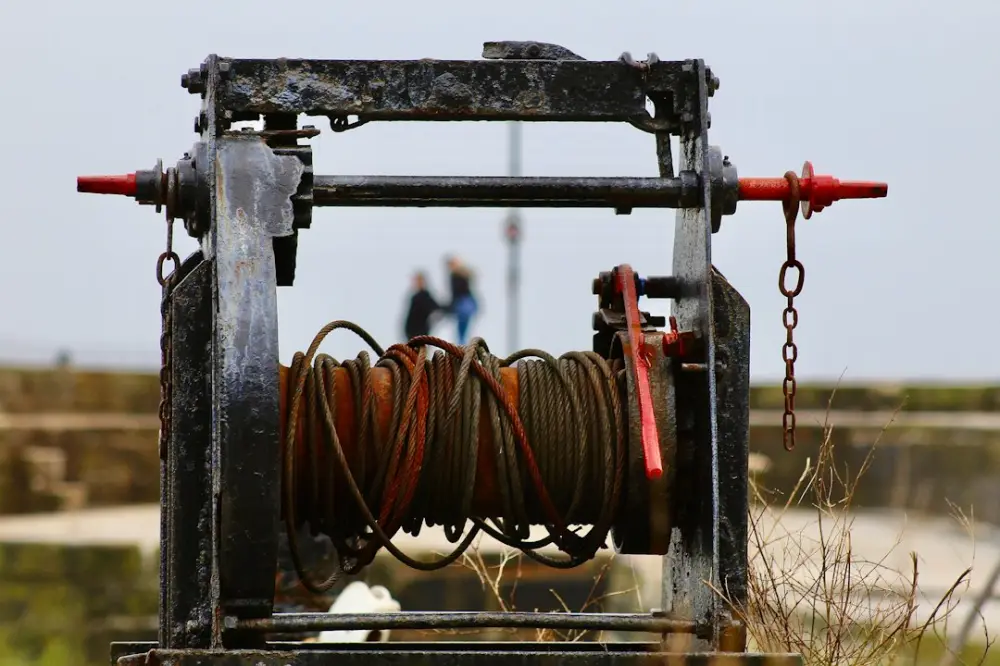
A winch load rating is the maximum weight a winch can pull on a single line under specific conditions, typically measured on the first layer of the drum. This rating serves as a mechanical limit for safe operation and is used to determine if a winch is powerful enough for a specific vehicle's Gross Vehicle Weight (GVW).
Understanding these ratings requires looking past the number printed on the box to the physics of the drum, the electrical draw of the motor, and the environmental resistance of the terrain. In coastal or off-road recovery, a rating is a baseline for calculation, not a guarantee of performance across all rigging scenarios.
What Winch Load Ratings Actually Mean
When a manufacturer labels a winch as "9,500 lbs," that figure represents the maximum pulling capacity on the first layer of cable wrapped around the drum. As the cable spools in and layers build up, the effective pulling power decreases. This happens because the increasing diameter of the drum gives the motor less mechanical advantage, essentially changing the gear ratio against the motor's favor.
It is also vital to distinguish between a pulling rating and a lifting rating. Most recovery winches are designed for horizontal pulling and lack the internal braking systems or safety factors required for vertical hoisting. For example, a winch rated for 10,000 lbs of pulling might only be safe for a fraction of that in a vertical lift, if it is rated for lifting at all. Using a recovery winch to hoist a heavy engine block or a structural beam is a common misuse that can lead to catastrophic brake failure.
Manufacturers determine these ratings in controlled environments, often on a flat, friction-free surface. In a real-world scenario, such as a truck stuck in axle-deep coastal silt, the "stuck factor"—the resistance created by the mud—can easily double or triple the effective weight of the vehicle. A 5,000-lb SUV buried in wet sand may require 12,000 lbs of force to move, meaning a winch rated exactly at the vehicle's weight will stall or overheat.
How Line Pull Capacity Changes During Operation
The physics of a winch drum are unforgiving. Every additional layer of rope reduces the winch's pulling power by approximately 10% to 15%. By the time the drum is nearly full (the fourth or fifth layer), a 12,000-lb winch might only be capable of pulling 7,000 lbs. This is why experienced operators often pull out more line than is strictly necessary to reach an anchor point; by getting down to the first or second layer, they maximize the motor's torque.
The type of line used also influences how these layers interact with the drum. We are seeing the growing shift toward synthetic ropes because they do not store as much kinetic energy as steel, but they also stack differently. Synthetic rope can flatten under tension, which may slightly alter the effective radius of the layer compared to rigid steel wire. However, the rule of thumb remains: the closer the rope is to the drum core, the stronger the pull.
Consider a scenario where a recovery vehicle is trying to pull a grounded skiff up a concrete ramp. If the winch is fully spooled, the motor will work harder, draw more amperage, and generate more heat to move the boat. If the operator uses a snatch block to double the line and reach the first layer of the drum, the mechanical stress on the motor is significantly reduced, even though the total pull time is longer.
Interpreting Manufacturer Specs for ATVs and Trailers
Small-scale winches, such as those found on ATVs, UTVs, or boat trailers, often have much shorter duty cycles than their heavy-duty counterparts. A manufacturer spec might list a 2,500-lb rating, but this may only be sustainable for short bursts. On an ATV, the winch is often used for plowing snow or pulling the vehicle out of light brush. In these cases, the electrical system of the vehicle is often the bottleneck; a small battery cannot sustain the high amperage draw required for a maximum-rated pull for more than a few seconds.
Utility winches on trailers are another specific category. These are often rated for rolling loads rather than dead weights. Pulling a 3,000-lb boat onto a trailer with working rollers is vastly different from pulling a 3,000-lb car with locked brakes onto a flatbed. When reading manufacturer guidance for trailer winches, look for the distinction between "rolling capacity" and "line pull." A winch that can easily pull a 5,000-lb boat on a trailer might fail instantly if asked to pull a 2,000-lb log across dry ground.
Manual winches used on smaller coastal docks or trailers rely on gear ratios rather than motors. Here, the manufacturer guidance focuses on the handle force required. If a manual winch is rated for 1,500 lbs, it assumes a human can provide a certain amount of torque to the crank. If the load exceeds the rating, the risk shifts from motor burnout to structural failure of the ratcheting pawl or the winch housing itself.
Avoiding Common Mistakes in Heavy Lifting and Rigging
One of the most dangerous misconceptions is that the winch's rating is the only limit that matters. In reality, every component in the rigging chain—shackles, tree savers, snatch blocks, and the mounting plate—must be rated to handle the potential load. If you use a 12,000-lb winch with a 5,000-lb rated D-ring, the D-ring becomes a projectile the moment the tension exceeds its yield point.
Shock loading is another frequent cause of failure. This occurs when there is slack in the line and the winch or the recovery vehicle suddenly takes up that slack at speed. The instantaneous force generated by a shock load can be several times the static weight of the object being pulled. A winch rated for 9,000 lbs can easily be stripped of its gears or have its cable snapped by a 4,000-lb vehicle if the line is jerked rather than tensioned gradually.
For example, when clearing debris from a coastal access road after a storm, an operator might be tempted to "tug" a fallen tree with the vehicle while the winch is engaged. This combines the force of the winch with the momentum of the truck, almost certainly exceeding the winch's rated capacity and the rope's breaking strength. Proper technique involves using the winch to do the work while the vehicle remains stationary and braked.
Essential Wiring and Maintenance for Reliable Pulling
A winch's performance is inextricably linked to the quality of its electrical connection. When comparing winch-system requirements: electric vs hydraulic, the primary limitation for electric units is voltage drop. If the wiring is too thin or the connections are corroded, the motor will not receive the amperage it needs to reach its rated capacity. This results in the motor stalling at loads well below the advertised rating.
In coastal environments, salt air is a constant threat to winch integrity. Corrosion inside the solenoid box or at the battery terminals increases resistance. High resistance leads to heat, and heat can melt insulation or cause the motor to burn out. Manufacturer guidance typically recommends using at least 2-gauge wire for winches in the 8,000–12,000 lb range, and even thicker wire for longer runs to the rear of a vehicle.
Regular maintenance should include checking the drum for burrs and ensuring the line is spooled under tension. If a steel cable is spooled loosely, the inner wraps can become trapped under the outer wraps when a heavy load is applied, a condition known as "binding." This can damage the strands and make it impossible to free-spool the winch later. A concrete example of good practice is to periodically unspool the line entirely and re-spool it while pulling the vehicle up a slight incline to ensure the wraps are tight and uniform.
Finding the Right Load Rating for Your Vehicle
The standard industry recommendation for selecting a winch rating is to take the Gross Vehicle Weight (GVW) and multiply it by 1.5. The GVW is not just the "curb weight" found in a brochure; it includes the weight of the fuel, passengers, cargo, and any aftermarket armor or racks. If a truck has a GVW of 6,000 lbs, the minimum winch rating should be 9,000 lbs. This 1.5x factor provides a safety margin to account for the loss of power on higher drum layers and the added resistance of mud or inclines.
However, for those operating in heavy mud or steep coastal terrain, a 2.0x multiplier is often safer. The extra capacity means the winch will run cooler and last longer because it is rarely pushed to its absolute mechanical limit. It is also important to consider the mounting hardware. A 12,000-lb winch is useless if it is bolted to a bumper that is only rated for 5,000 lbs of pulling force. The entire system must be viewed as a single unit where the weakest link determines the actual capacity.
At Winches Club, we emphasize that winch literacy is about understanding the intersection of mechanical limits and environmental variables. Whether you are managing coastal infrastructure or preparing a vehicle for remote recovery, interpreting manufacturer guidance is the first step in ensuring that your equipment performs when the tension is highest. By respecting the physics of the drum and the realities of electrical draw, you can move heavy loads safely and effectively.